
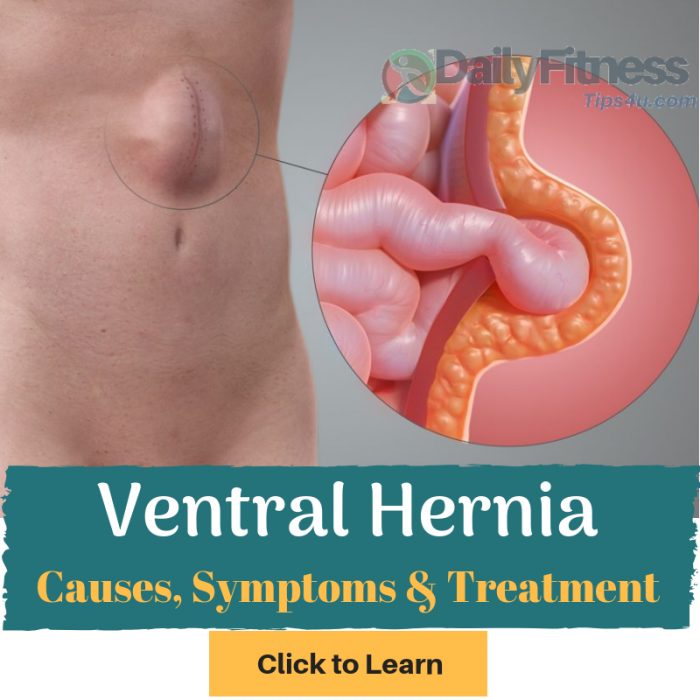
A ventral hernia is a lump or tissue swelling which occur in abdominal wall muscles due to weakness.
A ventral hernia also describes as incisional hernias because they occur in the healed area of the previous surgical hole. In this problem, the abdominal wall becomes thick and weak which creates an abdominal cavity to push through contents.
During a strangulated ventral hernia, the tissues of intestine become tightly trapped within the abdominal wall openings. Once it enters in the abdominal opening, then you cannot push it back in the abdominal cavity because the blood flow will stop. This kind of a ventral hernia requires emergency medical help and surgery.
A hernia can happen in another body part also such as the upper thigh is more likely to get a femoral hernia.
There are different types of hernia which include.
An inguinal hernia
Table of Contents
An inguinal hernia also describes as inner groin which is a common hernia occurring more in men. It happens when a torn or weak area in lower abdominal wall pushed by intestine especially in the inguinal canal. This kind of a hernia relates to aging, and it occurs if the abdomen walls frequently strained.
In men, the inguinal canal section locates in the abdomen to the scrotum where the spermatic cord moves. This cord retains the testicles. In women, the inguinal canal has a ligament which retains the uterus.
Incisional Hernias
It is an uncommon hernia type. An incisional hernia is a serious condition which requires surgery to correct it. After an open surgery in abdomen parts, some patients find difficult to cope with scar regions because a hernia often pushes through the abdominal wall. Apart from surgery, there is no other option to prevent the hernia push through.
These types of a hernia treated by only abdominal wall specialized surgeon Dr. Towfigh from Western United State. It requires extremely high skills for treating this condition.
Umbilical Hernias
This type of hernia commonly occurs in adult women. There is a possibility that it will occur in men also. Usually, it occurs due to defect of congenital in naval. It happens by birth but does not appear as a hernia until you put on weight or other health problems affect.
Some small umbilical hernias which happen in children will heal on their own. However severe cases need surgery to fix the problem permanently.
A hiatal hernia
It occurs in the upper stomach. A hiatal hernia is a condition which commonly occurs in the people with age of over 50 years. It occurs when the stomach swells up by diaphragm through the chest cavity. This type of hernia causes gastroesophageal reflux due to the leakage of stomach contents reverse back in the esophagus. It also creates a burning sensation in the affected person.
A femoral hernia
It is a hernia type, which occurs in the outer groin. This problem occurs more in women than men. The dropping of bowl parts or fatty tissues into the groin causes a femoral hernia. It occurs in the top part of the inner thigh.
This hernia type also relates to aging just like an inguinal hernia. It also happens due to repeated strain in the abdomen.
Causes of a ventral hernia
Various reasons can cause the body to experience a ventral hernia. A ventral hernia can present by birth or occur over time. A congenital hernia which presence by birth because of incomplete endings of the stomach wall. A hernia which occurs near your naval also a congenital.
A hernia which happens over the time befalls due to weak abdomen walls. Here are the main causes of a ventral hernia.
Weak Stomach Wall/lining
The tissues of your stomach or abdomen become weak due to an injury, normal weakness, gastritis.
Gastritis is the main cause of thinning the stomach walls due to inflammation. Certain foods, stomach acid, and digestive fluid also cause inflammation in the stomach lining which leads to weakening to stomach walls. Some other risk factor relates to gastritis such as
- Alcohol
- Tobacco consumption
- Digestive problem
- Autoimmune disorder
- Viral infection
- Cocaine
These all things affect the tissues of the stomach lining and causes a ventral hernia.
Unhealed Surgical Incision
After any surgery, the abdomen lining takes time to heal the Incisional area. Even a ventral hernia surgery itself cause repeated hernia problem due to the tissues weakness. The surgical spots remain unstable for a specific time. Therefore, if the wounds not heal in time or remain delicate can cause a ventral hernia.
Surgical Incision Infection
It is also a common cause of a ventral hernia. Often incision infections occur due to improper usage of surgical techniques or stitches, and poor care can result in incision infection.
The infection is more likely to occur in specific incision spots due to following reasons
- Obesity
- Coughing
- Sneezing
- Extra pressure
- Bowel movement
- Heavy lifting
These all things can forcefully push the internal tissues or organs in incision spots and cause infection which leads to a hernia. Additionally, smoking and stress also cause Incision Infection and hernia problem.
Hematoma
Hematoma also causes a ventral hernia. It is a blood accumulation outside of blood vessels and surrounding tissues. It happens due to the injury of blood vessels walls. The hematoma can occur from any injury of the artery, small capillary, and vein. It also describes as unstable blood clots whereas hemorrhage implies ongoing active bleeding.
If the accumulated blood trouble the surgery area will cause a ventral hernia.
Undernourishment
Malnourishment can cause severe a ventral hernia. Malnutrition is the effect of poor diet and lack of essential nutrition. It appears when your important nutrients are too high or too less and imbalanced.
Malnutrition can cause you growth delay, and more food without management can lead to obesity.
The complete cure of any surgery in the abdomen requires good nourishment. Proper care and poor diet cause ventral hernia.
To know that ventral hernia causing due to undernourishment, you can check the following symptoms.
- Constant feeling cold
- Appetite problem
- Concentration problem
- Muscles loss
- Frequent sickness
- Depression
- Unable to heal wounds
- Surgery complications
- Dry skin
- Breathing problem
Torn Stitches
You need to be cautious after undergoing an abdominal surgery because heavy lifting or sudden moving can create problems. Excess physical activity, stress, and infection after surgery can tear the stitches and causes a ventral hernia.
Obesity
Obesity describes as having BMI – body mass index of 30 or more. It is when you eat more calories than you burn in your everyday activities. Gradually, these calories build-up and cause to gain excess weight. Here are important conditions which lead to obesity.
- Poor diet
- Fast food
- Inactive lifestyle
- Aging
- Lack of enough sleep
- Polycystic ovary syndrome
- Cushing syndrome
- Prader-Willi syndrome
- Underactive thyroid
- Osteoarthritis
However, obesity doesn’t allow any surgery to heal fast due to excess fat. It makes the surrounding tissue of the surgery split and causes a ventral hernia.
A chronic Cough
A chronic cough can cause a ventral hernia. There is a possibility of bleeding in the stitches due to a cough after surgery. You need to treat a cough as soon as possible with medicine only prescribed by your doctor. An untreated cough makes the condition worse and leads to ventral hernia.
Old Age
Aging is an important cause of a ventral hernia. An aged person takes more time to heal any surgery in the abdomen. During the slow healing time, the surgery spot may get stress and strain which result in tearing of the wound. Also, the aged person’s immune system is not strong enough to heal the wound faster. Therefore, there are more chances of getting ventral hernia.
Symptoms of a ventral hernia
The symptoms of a ventral hernia vary from person to person. Some people have inflammation and pressure inside the abdomen. Some people don’t have any symptoms.
You will notice a bulge during a sudden cough or heavy lifting. A person with a ventral hernia can also experience pain which is also a symptom. Here are the details of important symptoms.
Pain
Normally you won’t feel the pain even if you touch the bulge. But confined hernia can cause you to experience the pain. The bulges which fail to go back into its original cavity in the abdomen. In an acute hernia, necrosis may occur, and blood supply to projected spot may cut off. It will lack the nutrition and organ tissue may die.
Bulge
The projected organ appears as a bulge in the affected person. Its appearance is visible even if the patient is lying down.
Nausea and Vomiting
The confined ventral hernia can cause discomfort in your abdomen. Due to discomfort and indigestion, the patient may experience nausea and vomiting.
No bowel movements
An individual who suffers from a ventral hernia can develop incapacity to have a proper bowel movement. The bulge may cause to block the stool.
Tenderness
The patient with a ventral hernia experiences the symptom of tenderness in the abdomen.
Rapid Heart rates
Due to the increased discomfort in the stomach, the ventral hernia patient may get rapid heart rates.
Growing bulge
Increasing bulge size is a symptom of a ventral hernia. It happens when ventral hernia surgery won’t heal properly and develop in large size over the time.
Diagnose Ventral Hernia
While the diagnosis of a ventral hernia, tests can be simple in mild conditions and complex in critical situations. You may ask to admit in the hospital so that your doctor can observe a ventral hernia properly.
During a physical test, your doctor may suggest you cough to check the appearance of the bulge.
Your doctor may request you to lie down flat with your legs bent to examine the size of bulge correctly.
To get the proper picture and recognition of a ventral hernia, your doctor may suggest the tests which include
Abdominal ultrasound
An ultrasound scan is a test method to capture the image and video of the body part through high-frequency sound waves. The ultrasound test can help your doctor to check the details of a ventral hernia in the abdomen. The doctor can find out where it locates, and which organ is getting affected.
Abdominal ultrasound is necessary to know the significant organs in the abdominal cavity. The major organs include the liver, gallbladder, kidneys, spleen, and pancreas.
CT scan of the Abdominal area
It is a computed tomography scan which provides specialized X-ray. This scan shows the cross-sectional picture of the significant body part.
During an abdominal CT scan, the doctor can able to check the blood vessels, bones and organs in the abdominal cavity. There may be multiple images with different information.
Abdominal MRI scan
It is a magnetic resonance imaging non-invasive test. It requires radio waves and magnets to create the image of the body part. MRI scan creates a cross-sectional picture of the abdomen. The doctor can analyze the organs and tissues abnormalities without any incision.
Additional Tests
- Urine test
- Blood test
- ECG for patients with age of over 45
Treatment
A ventral hernia needs proper treatment with healthy blood supply to all tissues and organs to prevent the destruction of organs and tissues.
Diagnosis of symptoms and causes is essential to decide the treatment method. Your doctor may suggest regular checkups for the observation of a ventral hernia. Provide your previous or ongoing medical problem information to your doctor. It will help to prevent the risk of developing a ventral hernia.
Surgery is the only treatment for a ventral hernia. During the surgery procedure, the projecting organ or tissue will be pushed back into the abdomen cavity. It will help to overcome the discomforting problems. If there is a huge size part such as the serous membrane, then it needs removal. The open abdominal wall will get closed to minimize the mesh happening again.
In some cases, without any major complications, the physician can push back the hernia into the abdominal cavity without any surgery. This procedure called ventral hernia reduction.
Laparoscopic surgery
It is a minimally invasive surgery to repair a hernia. Your doctor will use a telescope like equipment to perform the surgery through a small incision in the belly button. You will be given general anesthesia before surgery.
There will be no pain while performing laparoscopic surgery. It is inserted with a tiny video camera to view the inside part on operating room screen.
The abdomen contains carbon dioxide (harmless gas). It creates space to view the internal structure. The doctor will cut the abdomen lining to find the weakness on walls. Then, the mesh will be placed to cover the hole which helps to strengthen the affected tissues.
Open Surgery
It is an old method to repair a hernia. During this procedure, the doctor will make an incision in the abdomen and repair an outside-in hernia and close the incision.
Complications
A ventral hernia requires proper treatment at the right time to prevent serious complications. Here are the possible complications you may experience.
- Ventral hernia size increases and gets an infection
- Its pain get worse over the time
- You may notice changes in your posture
- Trouble bowl movements due to blockage.
- Internal bleeding in the abdomen
These all complications can cause life-threatening infection in the abdomen lining.
Prevention of a ventral hernia
Practice a healthy lifestyle to prevent ventral hernia problems. Follow the prevention tips.
- Treat constipation
- Get rid of cough problems
- Lose weight
- Practice yoga
- Take enough rest after surgery and avoid heavy lifting.
Ventral Hernia and Lifestyle
Here is the lifestyle change you need to practice during a ventral hernia.
- Avoid alcohol consumption which is a dangerous problem for a ventral hernia.
- Do light exercise to strengthen abdominal muscles. Avoid making abs which can put more pressure on the surgery area. Talking to your doctor before starting any exercise is a good idea.
- Wear loose and comfortable clothes because tight clothes can put more pressure on the stomach and cause discomfort.
- Avoid stress by practicing meditation. Stress can create more acid reflux and stomach pain problems.
- Avoid having large meals
- Avoid bending, sleeping and laying down after having a meal.
- Patient with a ventral hernia should not do exercise after a meal.
- Akkary, E., Panait, L., Roberts, K., Duffy, A., & Bell, R. (2011). Sutureless laparoscopic ventral hernia repair in obese patients. Journal of the Society of Laparoendoscopic Surgeons, 15(2), 154-159
ncbi.nlm.nih.gov/pmc/articles/PMC3148862/ - Ammar, S. A. (2009). Management of giant ventral hernia by polypropylene mesh and host tissue barrier: Trial of simplification. Journal of Clinical Medicine Research, 1(4), 226-229
ncbi.nlm.nih.gov/pmc/articles/PMC3299185/ - Hernia surgical mesh implants (2016, April 7)
fda.gov/MedicalDevices/ProductsandMedicalProcedures/ImplantsandProsthetics/HerniaSurgicalMesh/default.htm - Moon, M. A. (2015, December 29). New definition for massive ventral hernia? Retrieved from
mdedge.com/acssurgerynews/article/105479/general-surgery/new-definition-massive-ventral-hernia - Ventral hernia. (n.d.)
ucsfhealth.org/conditions/ventral_hernia/ - Ventral hernia repair (2014, May)
facs.org/~/media/files/education/patient%20ed/ventral_hernia.ashx - https://www.ucsfhealth.org/conditions/ventral_hernia/